
On November 13, 2026, the FBI issued a warning about ARTEX. ARTEX is a freely available tool that allows AI agents to infiltrate other organizations’ systems with little human involvement. According to the FBI, attackers have been using it worldwide since August 2026, targeting financial institutions, government agencies, healthcare organizations and law firms. On November 24, 2026, the Swiss National Cyber Security Centre (NCSC) reported the first confirmed cyberattacks with AI agents on companies in Switzerland.
- ARTEX does not use new attack techniques. It finds known vulnerabilities faster and at a lower cost. Check Point estimates the model costs of two campaigns at a few hundred to approximately 1,500 US dollars.
- The low cost of each attempt makes even small, time-consuming vulnerabilities worthwhile for attackers. You should therefore reassess vulnerabilities that you previously accepted as risks.
- Many effective security measures are well established, and implementing them does not require new investments. The checklist at the end outlines the steps in the order you should implement them.
What is ARTEX?
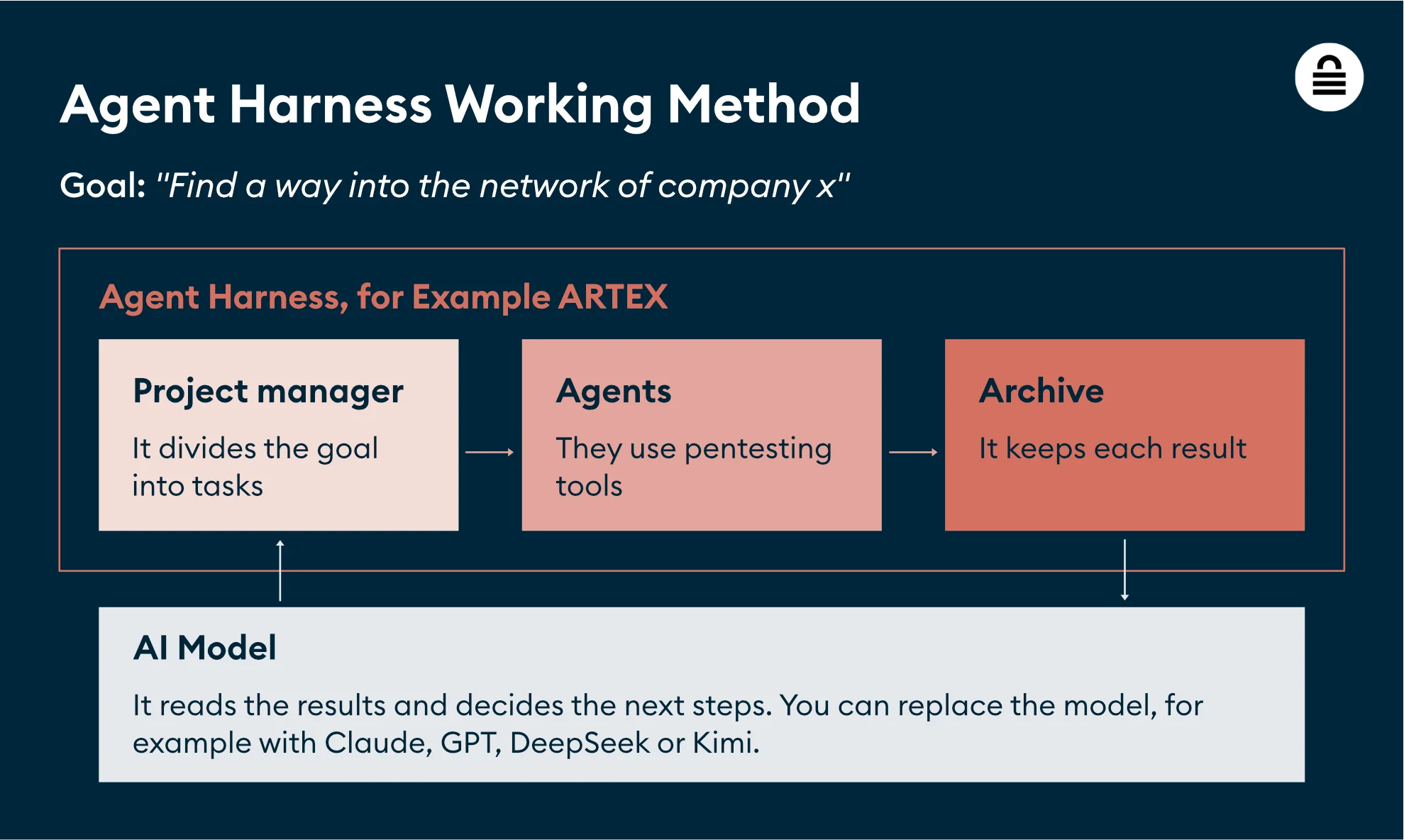
ARTEX is an agent harness. An agent harness is a software environment that connects an AI model with various tools and coordinates its tasks. It breaks a goal down into individual tasks, launches tools and stores each result. The model reviews the results and decides what to do next.
Think of it as a small consulting firm. The model is an external specialist hired by the hour. The agent harness is the firm itself, with project management, employees and an archive. The employees use the same tools as a human pentester.
ARTEX does not include its own model. It works with models from different providers, such as Claude, GPT, DeepSeek and Kimi. Attackers typically choose low-cost models without visible safety mechanisms. Blocking access through a single AI provider therefore does not stop ARTEX.
A developer using the pseudonym “Autumn-27” published ARTEX on GitHub in July 2026 as a tool for authorized penetration tests. Following reports of misuse, the developer withdrew the project on October 8, 2026. By that time, more than 12,000 copies already existed. However, ARTEX remains available through copies, modified versions and a commercial version.
Where Has ARTEX Been Used in Cyberattacks?
Three cases have been publicly documented:
- Financial institutions in South Korea: A financially motivated group stole the personal data of approximately 67,000 people.
- ConnectWise: Attackers used the credentials of an app provided by IT service provider ConnectWise. They attempted to access more than 2,250 Microsoft 365 tenants whose environments had granted the app access. Microsoft attributes the attack to a group linked to the Chinese state.
- Barracuda: The security provider had shared a cloud key with a service provider. The service provider stored it in a configuration file in its GitHub repository. Attackers gained access to its development environment and found the key there. According to Barracuda’s analysis, their methods were consistent with ARTEX.
In some cases, attackers used ARTEX to gain privileged access in less than three hours.
Switzerland is also affected. On November 24, 2026, the NCSC reported the first confirmed cases in which attackers used AI agents against companies in Switzerland. The cases affect companies and operators of critical infrastructure in at least two sectors. In every case known to the NCSC, the attackers compromised the IT systems. The NCSC does not name the tool that the attackers used. According to the NCSC, the number of AI agents such as ARTEX that are accessible from the internet has almost doubled since October 2026.
Why Does ARTEX Work? Attacks Have Become Much Cheaper
Amazon analyzed ARTEX campaigns observed through its own decoy systems. According to Amazon, none of the techniques were new. The agents succeeded where basic security measures were missing. They exploited default passwords, keys stored in source code, unauthenticated interfaces and outdated software.
The real difference is the cost. Check Point estimated the model costs of two criminal campaigns. One campaign cost approximately 145 to 300 US dollars and targeted 292 organizations. The other cost approximately 700 to 1,500 US dollars.
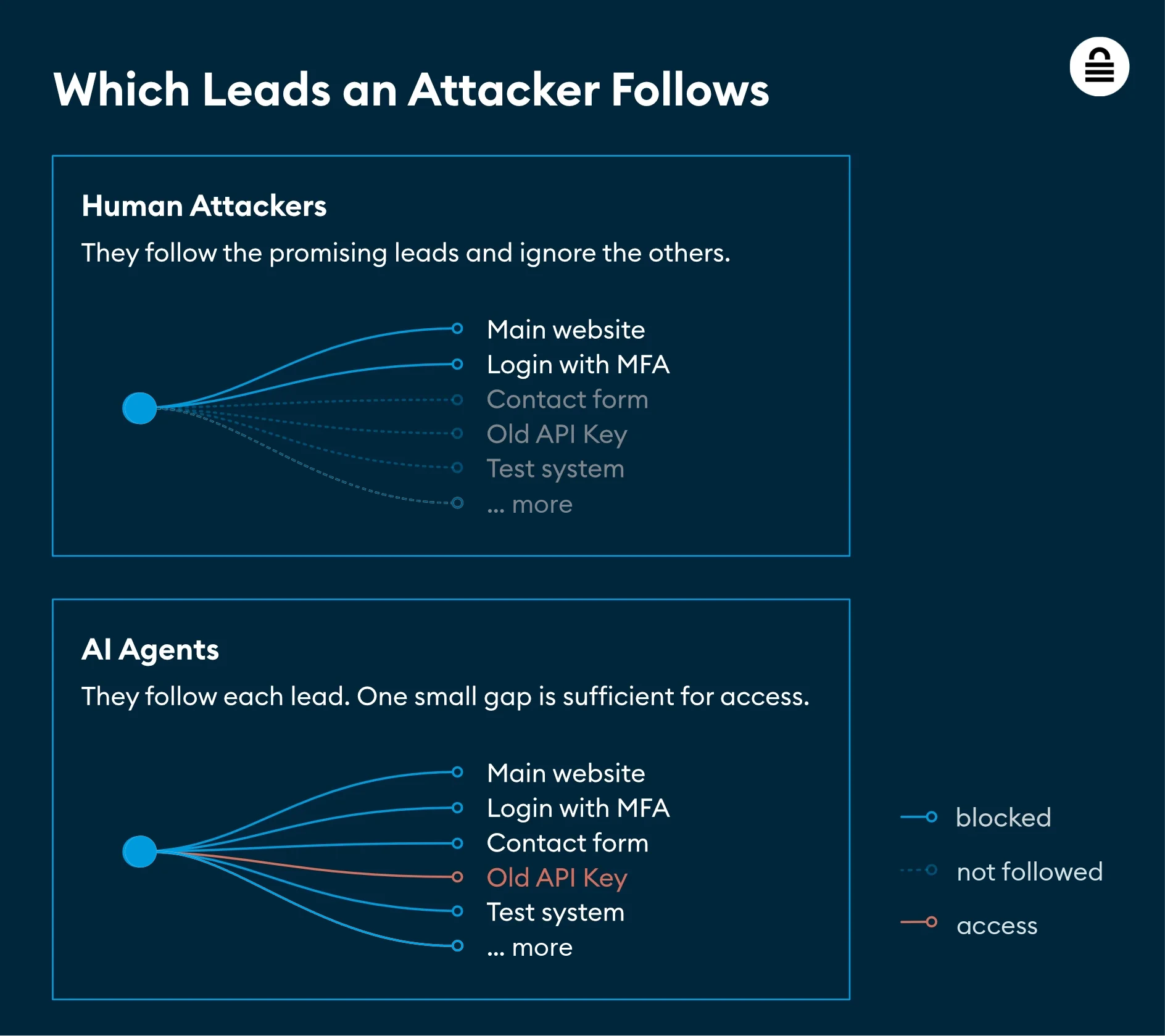
Human attackers have traditionally weighed their options. They followed promising leads and left difficult ones aside. Many companies relied on this. They accepted findings with a low risk rating in pentest reports as risks because the goal that an attacker could reach with them was not worth the effort.
An AI agent does not make the same choices as a human attacker. It can follow every lead, no matter how small. Examples include:
- An access key that nobody has rotated.
- A test system that remained accessible from the internet after a project ended.
- A contact form on a forgotten landing page.
- API access for an app from a completed project.
ARTEX is particularly effective against peripheral systems that receive less attention than the main application. These include partner portals, mobile backends, employee apps and legacy systems.
How Can Companies Protect Themselves Against ARTEX Attacks?
The established basics of IT security are effective against ARTEX. The NCSC recommends that companies in Switzerland implement the following measures without delay:
- Limit exposed systems: Reduce the number of systems that are accessible from the internet. Restrict access to these systems, for example with geo-blocking or an allow list.
- Install security updates quickly: Install critical security updates for these systems as soon as possible, but no later than 24 hours after release.
- Use multi-factor authentication (MFA) or passkeys: Protect every internal resource that is accessible from the internet with MFA or passkeys. Examples are webmail and VPN.
- Restrict access rights: Grant access rights according to the principle of least privilege.
- Detect deviations: Make sure that you detect when identities, applications or systems deviate from their usual behavior.
- Run penetration tests regularly: Test your IT infrastructure regularly for vulnerabilities, either yourself or with external specialists.
The checklist at the end of this article adds individual check steps to these recommendations.
An example shows that these basics work. The group behind the ConnectWise attack also attempted to guess passwords automatically. It targeted 327 accounts across eight organizations. Microsoft recorded more than 151,000 failed sign-in attempts. Almost 98 percent resulted in account lockouts, and not a single sign-in succeeded.
Account lockout is an effective security measure that many companies have used for years. However, strict lockout policies have a downside: attackers can deliberately lock users out of their accounts. Our article “Password Spraying: Procedure, Risks and Protective Measures” therefore recommends gradually increasing the time between sign-in attempts.
These basic measures also have their limits. Account lockout and multi-factor authentication protect human sign-ins. In the ConnectWise attack, no person signed in because the app used its own credentials. These types of access require separate controls. Our article “Cybersecurity: Guarding Against Unauthorized Access and How to Protect Against It” describes the five most common entry points and nine countermeasures.
Why a New AI Product is Not the First Step
Companies should take ARTEX seriously. Its low attack costs make even smaller companies attractive targets. Attackers can also reach their objectives within just a few hours.
Many vendors currently promote products as “AI-powered” for penetration testing, SOCs and blue teams. Some of these products are useful. However, they cannot close vulnerabilities that already exist. The CISO of Barracuda makes a similar point: companies that focus only on detection and response often arrive after the attacker has finished. Our article “AI: Competence or Illusion?” takes a closer look at the benefits and limitations of AI.
Most attackers choose the cheapest route. State-sponsored actors with substantial resources are an exception. Closing these easy entry points makes every attack more expensive. This requires an inventory of your systems, time-limited credentials and control over apps with access to your environment. These measures mainly cost time, not license fees.
Detection and response remain essential. However, prevention should come first. We recommend closing known vulnerabilities before investing further in detection. It is therefore important to identify vulnerabilities and then to close them completely and without delay.
How Oneconsult Uses AI
We use AI ourselves and recognize its value. In code reviews, AI helps us analyze large amounts of source code more quickly. During reconnaissance, it helps us identify valid usernames, for example. In penetration tests, we also use an agent harness that is defined specifically for penetration tests.
The difference from an attack lies in the framework. We only test with authorization, within the agreed scope and under strict confidentiality. We use AI where it is useful and permitted. A pentester reviews every result before it is included in a report.
We do not recommend running an ARTEX copy against your own systems. The original project has been withdrawn, and copies come from unknown sources. Anyone operating an agent harness should isolate it and keep production credentials away from it. Network rules must restrict its access. A prompt instruction alone is not sufficient. Our article “AI Agent Security: Threats and Attack Vectors” explains how AI agents themselves can be attacked.
Checklist: What You Should Check
These steps are based on recommendations from the FBI, the NCSC, Microsoft and Amazon. Most do not require new investments. Many vulnerabilities can be found with vulnerability scans and other security tests. Our article “Vulnerability Scanners: How to Protect Your Company” explains how vulnerability scanners work. The steps are listed in the order in which you should implement them. We are happy to support you in setting up and carrying out these steps.
Reduce Your Attack Surface
- Create an inventory of all systems accessible from the internet. Include domains, subdomains, IP ranges, cloud accounts, login pages and APIs. Also include systems operated by your suppliers.
Check question: Which systems did we put online for a project or a test and then forget about? - Shut down systems that are no longer needed. Examples include old landing pages, test systems, forms and apps from completed projects.
- Remove management interfaces from the public internet. Admin pages, backup consoles and cloud management interfaces should only be accessible through a VPN or a dedicated management network.
Reassess Accepted Risks
- Reassess every accepted finding in your latest pentest reports, including findings with a low risk rating.
Check question: Could this finding help an attacker who follows every lead?
Set Expiration Dates for Credentials
Keys are credentials for programs. Examples include API keys, tokens and certificates. A program uses them to sign in to a system without a person entering a password.
- Search code repositories, configuration files and logs for exposed keys and passwords.
- Replace every key you find, even if it was only stored internally.
Check question: Which of our credentials are still active even though they are no longer needed? - Revoke a supplier’s keys on the day their contract ends.
Control Apps and Service Accounts
- Identify third-party apps with access to your cloud services, for example Microsoft 365 or Google Workspace. Remove any permissions they do not need.
- Maintain an inventory of all app integrations and service accounts, including their owners, purpose and expiration dates.
Check question: Which apps operate in our systems without a person signing in? - Set up an alert whenever someone adds new credentials to an existing app. Our article “Threat Hunting in Azure Active Directory and Microsoft 365” explains which log entries can indicate an attack on Microsoft 365.
Detect Unusual Activity and Access Patterns
- Limit the number of requests to portals and APIs (rate limiting).
- Set up an alert when an account reads significantly more data than usual.
- Define in writing which actions your systems can take without approval. One example is terminating a suspicious session.
Run the Friday Test
- Place a decoy in your network, known as a canary token. For example, this could be a fake cloud key on a build server. Nobody needs it for their work, so every access attempt triggers an alert.
- Trigger the decoy yourself on a Friday evening. Measure how long it takes for someone to respond. If nobody reacts until Monday, you have identified a gap in your detection process.
Conclusion: Strong Security Fundamentals Still Matter
ARTEX does not change the fundamental methods used in cyberattacks. It mainly changes their speed and economics. AI agents can systematically identify and exploit known vulnerabilities. As a result, even small security gaps that were previously considered low risk become attractive targets.
Companies should therefore review their attack surface, check existing credentials and app permissions, and reassess previously accepted risks. The priority is not to introduce new AI security tools as quickly as possible, but to close existing vulnerabilities consistently.
Would you like to know how well your IT infrastructure is protected against automated cyberattacks? Oneconsult can help you identify vulnerabilities and define appropriate security measures through targeted penetration tests. Contact us to find out more.
Sources
- FBI: FLASH-20261113-001, “Threat Overview of ARTEX Autonomous Penetration Testing Framework”, November 13, 2026. ic3.gov
- National Cyber Security Centre (NCSC): “Cyberattacks involving AI agents: First confirmed cases in Switzerland”, November 24, 2026. bacs.admin.ch
- Amazon Threat Intelligence: “Amazon Threat Intelligence observes threat actors running cybercrime campaigns with ARTEX AI agents”, November 13, 2026. aws.amazon.com
- Microsoft Threat Intelligence: “AI-driven, large-scale nation-state campaign using ARTEX enables supply chain compromise”, October 21, 2026. microsoft.com
- Microsoft Threat Intelligence: “ARTEX abuse expands as cybercriminals target financial sector”, November 6, 2026. microsoft.com
- Check Point Research: “Hacking on Autopilot: Inside ARTEX Cybercrime Campaigns”, November 5, 2026. research.checkpoint.com
- Barracuda: “Barracuda XDR Integration Credentials”, update of November 13, 2026. trust.barracuda.com
- TechCrunch: “FBI says Artex AI open source hacking tool used to breach networks in ‘under three hours'”, November 16, 2026. techcrunch.com
- Help Net Security: “ARTEX goes from pentesting tool to attacker staple in three months”, November 9, 2026. helpnetsecurity.com
- The idea for the Friday test comes from the video “ARTEX Explained: The AI Hacking Tool the FBI Warned About” from the channel AI Security, November 18, 2026. youtube.com